


More in Common Than Not: A Cross-Generational Conversation in the Battery Industry
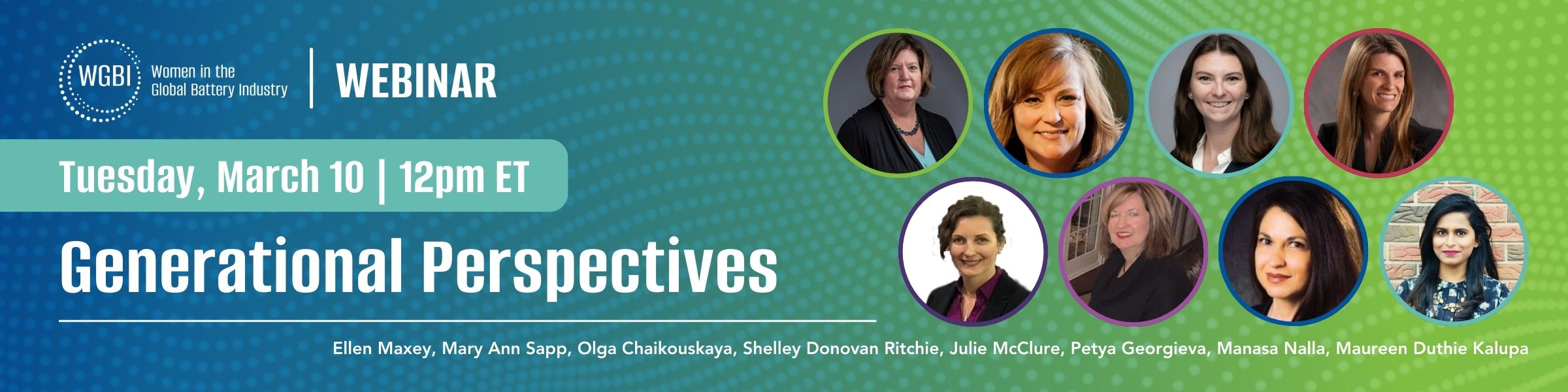
On March 10, 2026, the Women in the Global Battery Industry (WGBI) hosted its first official webinar of the year — a dynamic and candid conversation spanning four generations. Moderated by Ellen Maxey of Clarios and Chair of the WGBI Education Committee, the “Generational Perspectives” panel brought together seven professionals from Baby Boomers to Millennials to explore how generational identity shapes the way people work, communicate, and lead. The result was a rich, honest dialogue that challenged stereotypes and revealed far more common ground than dividing lines.
Meet the Panelists
The panel featured voices from across the generational spectrum. Mary Ann Sapp, Quality Lab Manager at Hammond Group, represented the Baby Boomers. Generation X was represented by Olga Chaikouskaya, CPA and CFO of Eagle Oxide Services, along with Julie McClure, CEO and Chairman of MAC Engineering & Equipment Co., Inc., and moderator Ellen Maxey of Clarios. The Millennial generation was represented by Shelley Donovan Ritchie, PMP, MSPM, Program Portfolio Manager at Clarios; Petya Georgieva, MS, CSP, also of Clarios; Manasa Nalla, Associate Director of Research and Development at Duracell; and Maureen Kalupa, Lead Materials Engineer at Clarios. Kalupa, born in 1995, described herself as a young Millennial who relates to both generations.
Do You Align With Your Generation?
The panel opened with a question that immediately sparked lively discussion: do you actually identify with the generation you were born into? The answers were nuanced. Shelley Ritchie embraced her Gen X identity, describing it as “not looking for perfect, just not too much complaining, just get the job done.” Manasa Nalla offered a more global perspective, observing that “generational labels provide context, but I don’t think they fully define how people think or work” — particularly given that a millennial’s experience in the US may look very different from that of a millennial raised in another country. Maureen Kalupa described her own in-between identity plainly: “I’m in the in-between where like we had a home computer right away, but I know how to use a floppy disk,” adding that having a cell phone in middle school was “not a typical millennial experience.”
Generational Strengths at Work
Each panelist spoke to the defining strengths of their generation. Mary Ann Sapp highlighted the Baby Boomer hallmark of commitment, noting “we tend to have an extremely strong work ethic and a very strong dedication to family, work and the company.” Olga Chaikouskaya described Gen X as natural bridge-builders: “In leadership roles I often find myself naturally playing this integrator or translator role, kind of helping on different teams and different generations understand each other.” Petya Georgieva championed Millennial agility and the ability to pivot: “We’re not afraid to start over, to move, shift careers. We hustle and adapt faster than any other generations.” She shared that she left her home country in her early 20s with a suitcase and a few hundred dollars, has moved 13 times, lived in six different states, and is already on her third career.
Learning Across Generations
A recurring theme was the value of learning flowing in both directions across generational lines. Julie McClure shared two pieces of wisdom that stuck with her from earlier generations: her father’s reminder that “if you think you’re making what you’re worth, you need to reevaluate what you’re worth,” and her mother’s counsel that “you can have it all, but you just can’t have it all at once.” Mary Ann Sapp credited younger generations for modeling self-advocacy: “I really admire how they’re more assertive and stand up for themselves.” Maureen Kalupa emphasized the mutual nature of mentorship, noting that “there’s a lot of reverse mentoring that can go both ways” and encouraging experienced colleagues to “really challenge us and push us because we can do it.”
Communication Styles and Preferences
The panel devoted meaningful time to how different generations prefer to communicate — and where friction can arise. Maureen Kalupa pointed to a surprisingly telling example: the use of ellipses. To older colleagues, ellipses signal the end of a thought; to younger ones, they read as uncertainty or a trailing idea — “those can cause miscommunications really quick unless you understand each other’s perspective.” Petya Georgieva advocated for directness as the universal solution: “if we can discuss an issue and a solution for 5 minutes in the office hallway, why do we need to spend the time… and schedule one hour meeting to get a 5 minutes point across?” She added that her guiding principles in any generational context are to “always communicate with respect, be humble and stay open to diverse perspectives.” Olga Chaikouskaya agreed that while quick texts work for routine matters, “face-to-face conversations still have a lot of value” when it comes to strategic or difficult discussions.
Work-Life Balance and Setting Boundaries
Work-life balance generated some of the panel’s most spirited exchanges. Julie McClure acknowledged that her approach as a CEO is non-linear but emphasized that “you have to find your own way to work-life balance” within your constraints. Maureen Kalupa called for leaders to model healthy boundaries: “if you’re a leader, you need to set the example that you do not need to respond on Saturdays and Sundays so that other people don’t feel like they need to do that.” Manasa Nalla tied the pressure to over-respond to a deeper pattern: “I think it stems from us wanting to be people pleasers, right? I think especially women, we want to be liked.” Her parting thought drew on a Michelle Obama reference: “we don’t have to please everyone” — a sentiment that resonated across every generation on the call. Olga Chaikouskaya brought a deeply personal note, reflecting that “life is now” and urging everyone to re-examine how they allocate time to what truly matters.
Parting Thoughts: More in Common Than Not
As the formal discussion gave way to closing reflections, a powerful consensus emerged. Petya Georgieva pushed back on the stereotype that Millennials are lazy: “We’re one of the hardest working generations… but that’s only if we’re in an environment where we’re challenged, where we can continue to grow and where we’re valued.” Olga Chaikouskaya offered perhaps the panel’s most resonant observation: “I feel like we all want the same things, right? We want to be successful. We want to have a good work-life balance. We want to make impact.” Mary Ann Sapp reinforced this, calling it “truly important to value blending the old and the new, because each generation brings unique perspectives and experiences.” Julie McClure closed simply: “flexibility is a strength, not a weakness” — and Shelley Ritchie encouraged everyone to “approach people with the best intent” and take the time to show the way for the next generation.
The “Generational Perspectives” webinar was more than a year in the making, according to moderator Ellen Maxey, and it delivered on every expectation. WGBI members interested in shaping future programming are encouraged to get involved with the Education Committee. Members are also reminded to renew their 2026 WGBI membership and to watch for upcoming details on the return of the WGBI mentorship program.

Mary Sapp, Hammond

Julie McClure, MAC
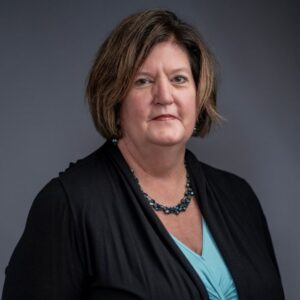
Ellen Maxey, Clarios

Olga Chaikouskaya, Eagle Oxide

Manasa Nalla, Duracell

Shelley Donovan, Clarios
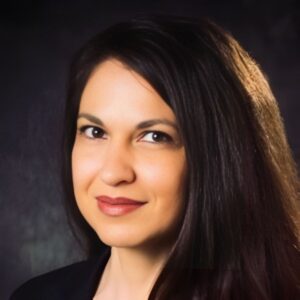
Petya Georgieva, Clarios

Maureen Kalupa, Clarios