


Beyond the Paycheck: WGBI Webinar Covers The Real Reasons Good People Stay
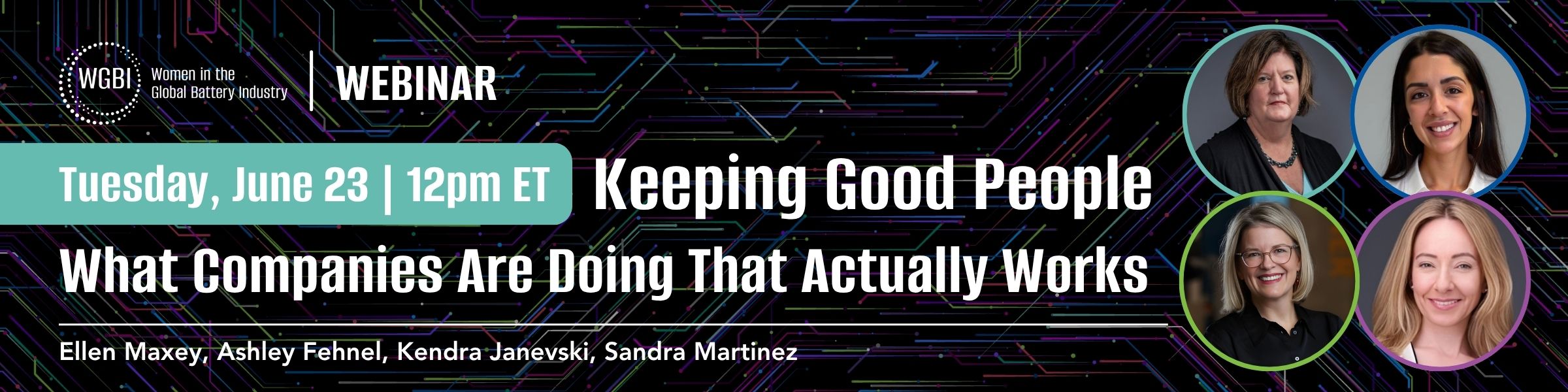
On June 23, 2026, the Women in the Global Battery Industry (WGBI) hosted a follow-up to one of the most well-received sessions from this year’s BCI convention — a candid, practical panel on employee retention. Moderated by Susan Bernard, WGBI’s Director, the conversation brought back two original convention panelists, Sandra Martinez and Kendra Janevski, joined by Ashley Fehnel, for a second round of insight on what actually keeps good people in their seats.
Bernard credited Ellen Maxey, longtime chair of WGBI’s member education subcommittee, whose conversations across the industry surfaced a consistent thread: retention is the challenge companies keep circling back to, regardless of department or seniority. The topic resonated so strongly at convention that Bernard wanted to bring it to the broader membership.
Meet the Panelists Kendra Janevski is Managing Director of Vault Consulting, providing outsourced HR, accounting, and research services primarily to smaller organizations. Sandra Martinez is Chief People Officer at Hollingsworth and Vose, a seventh-generation family-owned company, where she has spent three years adapting HMV’s culture through organizational transformation. Ashley Fehnel is Global Director of Human Resources at EnerSys, supporting most of the company’s global manufacturing operations, with a focus on development pathways, leadership behavior, and employee connection to mission.
Why Retention Is a Business Issue Martinez framed turnover as far more than a staffing inconvenience: replacing an employee costs roughly four times their compensation and can take four months to backfill a critical role, draining institutional knowledge and pressuring remaining staff. There’s also a morale ripple effect — when a respected high performer leaves, colleagues wonder if they’re missing something too. Turnover, she argued, is a symptom, often of leadership issues further up the chain, and disengaged employees who haven’t left but are quietly checking out pose a similar risk.
Janevski added that not every employee who stays is necessarily the future of the company, and leaders need to be deliberate about who they’re doubling down on retaining. The language has shifted, she noted, from “great resignation” to “quiet quitting” to “job hugging,” where employees cling to roles for reasons that may not serve them or the organization well.
Why People Actually Leave Janevski walked through four research-backed categories: employee experience (Gallup found 50% of employees leave because of their manager, and MIT found toxic culture ten times more predictive of attrition than pay), workplace well-being (the APA reported 57% of workers experiencing negative impacts from workplace stress, and Deloitte names burnout a top-three reason for departures), basic economics (Pew found 63% of employees cite low pay as a factor), and growth and development (LinkedIn found 94% would stay longer if they felt invested in, while McKinsey lists lack of advancement among the top three global reasons for quitting).
Martinez added a fifth thread: human connection. At HMV, a three-day hybrid policy at headquarters has sparked conversation about in-person time’s value, and she’s noticed early-career employees, particularly Gen Z, are often the ones most drawn to being physically present.
Why People Stay Fehnel offered four factors that keep high performers and future leaders in place: seeing a future for themselves, strong leadership that coaches and recognizes employees as genuine partners, post-pandemic flexibility and balance (EnerSys’s hybrid schedule preserves both routine and informal connection), and total rewards that make sense now that compensation information is no longer gatekept by HR.
Janevski echoed an often-overlooked Gallup point: whether employees feel they have a “best friend at work” — a question leaders sometimes dismiss but that captures something real about belonging. Martinez agreed, adding that long-term incentives are increasingly on employees’ minds, even early in their careers.
Building Development That Actually Works Martinez emphasized that training alone rarely sustains engagement — what matters is connecting skill-building to a visible career path. At HMV, this has meant identifying “load-bearing roles” critical to long-term goals, assessing required skills, and closing talent gaps internally or externally, including continued investment in AI and emerging technologies even before their full impact is known.
Fehnel described EnerSys’s approach as intentionally simple: development conversations built around three questions — how employees want to grow, where they need development, and how the organization can support them. Asking directly, rather than assuming, has surfaced real gaps between what managers expect of an employee’s future and what that employee actually wants.
The Hard Truths Asked what companies try that doesn’t work, Janevski pointed to flashy recognition programs built without real employee input — the fix isn’t complexity, but consistent, high-quality check-ins rooted in actual feedback. Martinez agreed: technology and process can only go so far if managers aren’t genuinely present and invested in their people’s growth.
On leadership behaviors that drive good employees away, Fehnel called out the absence of real-time recognition beyond annual reviews and a “what have you done for me lately” mentality common in manufacturing. Her conclusion: employees tolerate heavy workloads and change, but not feeling invisible. Janevski added that opening multiple feedback channels, even when uncomfortable, helps surface systemic issues early.
Practical Advice to Take Home Each panelist left attendees with one takeaway. Fehnel’s: give your critical talent “a big hug” — not literally, but through deliberate attention, follow-through, and clarity about their future with the organization. Janevski’s: invest in your managers, since they translate retention strategy into daily reality. Martinez’s: have the honest, simple conversation — “How are you doing? How are you feeling about your future here?” — especially with the load-bearing employees a company can’t afford to lose.
On Gen Z In the closing Q&A, Martinez and Janevski pushed back on the narrative that younger employees are less committed. Martinez described working with highly engaged, fast-learning Gen Z colleagues who thrive when given a genuine sense of belonging and room to grow, pointing to reverse mentoring as a valuable two-way exchange. Janevski added that Gen Z’s expectations are shaped by watching their parents’ generation lose access to pensions and long-term security, leading many to prioritize strong financial benefits and real development over perks like office games or happy hours.
Bernard closed by summarizing the throughline: retaining strong people isn’t a single fix, but a combination of leadership, culture, communication, and real opportunities for growth — and she encouraged attendees to take at least one idea back to their own teams.
Save the Date WGBI members are encouraged to renew their 2026 membership and to mark their calendars for two upcoming webinars: Transportation Forecast on August 11, and Flow Batteries 101 on September 10. More details will be shared with the full membership soon.